What Exactly Is an ATS?
An Applicant Tracking System (ATS) is software that companies use to manage job applications at scale. When you hit "Submit" on a job board like LinkedIn, Indeed, or a company careers page, your resume doesn't land in a recruiter's inbox — it goes into an ATS database first.
The software automatically parses your resume, extracts information like your job titles, skills, education, and dates, and then scores or ranks you against the job description. Candidates below a certain threshold are filtered out automatically. The recruiter may never even know you applied.
According to multiple HR surveys, over 98% of Fortune 500 companies use an ATS. Even mid-sized companies and startups now rely on tools like Greenhouse, Lever, Workday, and Taleo. If you're applying to any company with more than 50 employees, there's a very good chance an ATS is reading your resume before any human does.
Key Insight: ATS rejection isn't about being underqualified. It's about your resume being formatted or worded in a way the software can't correctly parse. A perfectly qualified candidate with a poorly formatted resume loses to a less qualified candidate with a clean, ATS-optimised one.
How ATS Actually Reads Your Resume
ATS software doesn't "read" your resume the way a human does. It parses it — meaning it attempts to extract structured data from unstructured text. It's looking for specific fields: contact information, work experience (with dates), job titles, education, skills, and certifications.
When it encounters formatting it doesn't understand — tables, columns, text boxes, unusual fonts, headers embedded in images — it either skips that content entirely or misfiles it in the wrong field. A candidate whose skills section ends up blank in the ATS database will score zero for keyword matching, regardless of what's actually on their resume.
This is why resumes that look beautiful in a PDF viewer often perform terribly in ATS. Visual design elements that impress humans actively confuse the parser.
The 5 Most Common Reasons Resumes Get Rejected by ATS
These are the patterns that cause automatic rejection most often, based on how ATS parsing engines actually work:
Tables and multi-column layouts
Many ATS parsers read left-to-right across columns, jumbling your content. A two-column resume where skills appear beside experience often gets parsed as a single garbled paragraph. Use a single-column layout for any resume that will be submitted digitally.
Non-standard section headings
ATS systems are trained to recognise "Work Experience", "Education", "Skills", and "Summary". If you use creative labels like "My Journey", "Where I've Been", or "What I Bring", the parser may fail to categorise that section and skip it entirely.
Missing keywords from the job description
ATS ranks resumes partly by keyword frequency. If the job posting says "project management" and your resume says "led projects", the match score may be zero for that term even though the meaning is identical. Mirror the exact language from the job description wherever honest.
No quantified achievements
Modern ATS systems, especially those with AI scoring layers, actively penalise bullet points that read like job descriptions rather than achievements. "Responsible for social media" scores lower than "Grew Instagram to 4,200 followers in 6 months." Numbers signal credibility.
Contact information in headers or footers
Many ATS parsers ignore the header and footer regions of a PDF entirely. If your name, email, or phone number lives only in the document header, it may simply not be extracted — making your application invisible even if your content passes.
What a Good ATS Score Actually Looks Like
ATS scores are not standardised across platforms — a 72% on one system might be equivalent to an 85% on another. What matters more than the raw number is understanding what's being flagged.
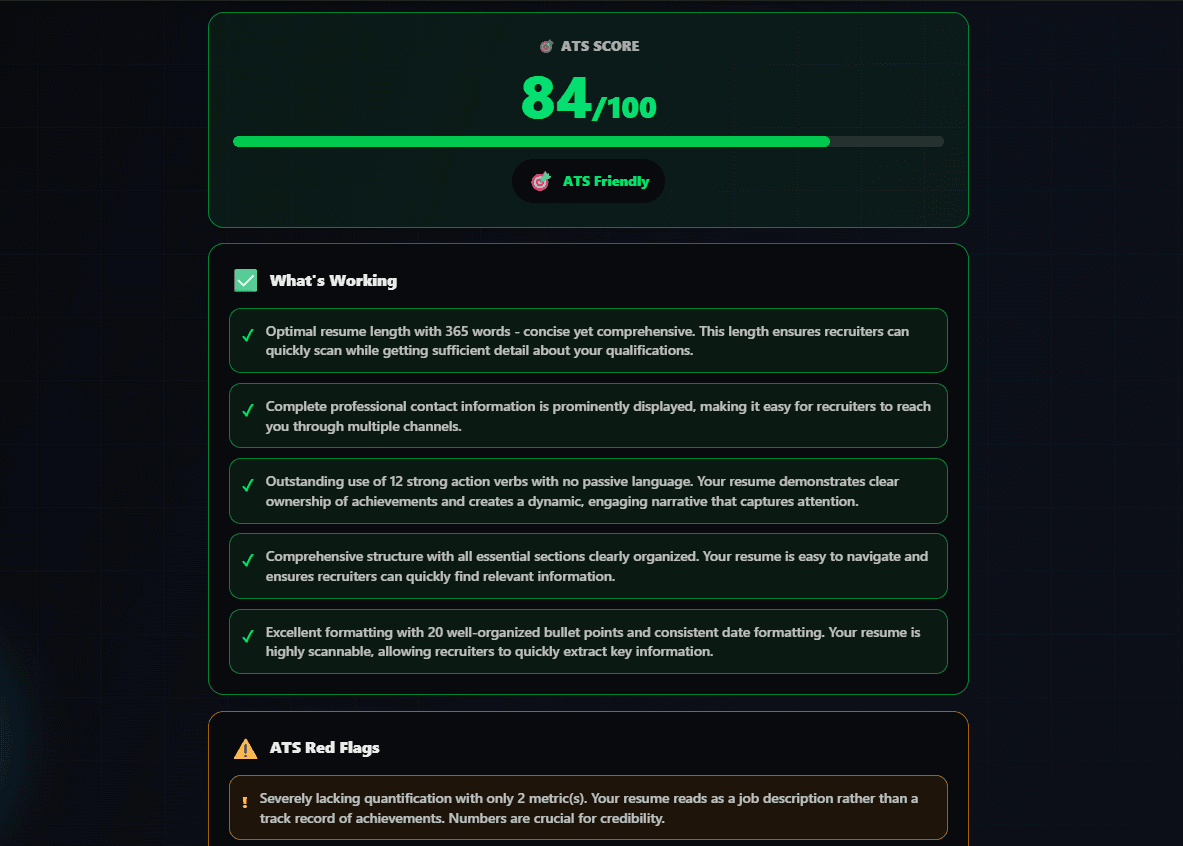
A well-structured resume typically scores in the 85–100 range on the FlexoTools scorer, reflecting strong keyword usage, clean formatting, quantified achievements, and complete section structure. Scores in the 65–84 band pass most systems but have addressable gaps. Anything below 65 is likely to be filtered automatically by stricter ATS configurations.
How to Write a Resume That Passes ATS
None of this requires you to make your resume worse for humans — a clean, well-structured resume reads better for both. Here's the practical checklist:
Does Tailoring Your Resume for Every Job Actually Matter?
Yes — and more than most people realise. ATS systems score resumes against the specific job description, not against a generic standard. A resume that scores 90 for one role might score 55 for a different role at the same company if the required keywords are different.
The practical implication: you don't need to rewrite your entire resume for every application, but you should update your skills section and adjust 2–3 bullet points to reflect the language used in each job posting. This alone can move a borderline resume from filtered to shortlisted.
Check Your Resume Right Now — Free
Upload your PDF and get an instant ATS score with a specific breakdown of what's working and what's holding you back. No signup required to see your score.
🎯 Check My ATS Score